Scrap-fi
It started with one "spare" CPU.
Since then I've bought a motherboard from AliExpress, a second one secondhand, two more CPUs, two graphics cards, and a pair of RAM sticks that cost more than anything else. At the end of it I should have a powerful compact server, an upgraded PC, and enough components to build another computer -- which, naturally, I'm going to put inside a 3D-printed replica of the first computer I ever owned.
There should be a word for this; I've been calling it scrap-fi: scifi where the technology isn't sleek or new but salvaged, built from scraps and archaic components and MacGyver'd into working by whoever has a screwdriver and the patience.
Star Wars is the best example I know. It feels lived in precisely because it embraces scrap-fi: every corridor is littered, every home is full of useful components being endlessly recycled. Firefly does it too: Serenity is an old boat that stays in the sky because Kaylee keeps making tired parts do one more job.
Games love it. Star Wars Outlaws brings that lived-in galaxy to street level, where upgrades are traded and your engineer figures out how to integrate them. Machinarium is a whole city of rusting robots, and its hero starts the game in pieces on a scrapheap. In Stray, the robots get by on whatever the humans left behind. There's even a scrap-fi streak in cyberpunk: a ripperdoc bolting chrome into someone in a back-alley clinic is the same instinct, applied to people.
I'm also reading Peter F. Hamilton's Exodus at the moment, which is full of "remnant" tech beyond anyone's understanding, and Travellers' ships held together over centuries by ingenuity and spare parts. But it turns out that scrap-fi is probably less fictional than I thought.
One spare CPU
My son got a CPU upgrade (AMD Ryzen 7 5700X) for his birthday, seeing as I'd already swapped my 4070 for his 2070 and made his CPU the bottleneck. This left his "old" Ryzen 5 3600 sitting on my desk: six cores, twelve threads, a few years old and nowhere near dead. It stayed "spare" long enough for him to forget that he was going to sell it ... I had different plans.
Our little NAS was the obvious home for it. It runs Proxmox on the ASRock QC5000-ITX I built it with back in 2022, an AMD "Kabini" A4-5000 that was underpowered even when I bought it (but powerful enough for some web apps and file shares). The 3600 would be a huge step up, but a CPU needs a motherboard and the Jonsbo N2 case only takes mini-ITX. I took a gamble and bought a JGINYUE B350I-PLUS on AliExpress.
I'd never heard of the brand, and never bought a motherboard online from China. What I should have realised is that the Kabini and my PC both use DDR3, but all AM4-based systems need DDR4. No easy swap.
DDR4 is weirdly expensive right now. The big memory makers are pouring their factory capacity into HBM, the high-bandwidth memory that goes into AI accelerators, and that's squeezed every kind of RAM. DDR5 got so expensive that the industry did something you'd never expect: it went backwards. Memory makers kept DDR4 lines running that were meant to be shut down, and motherboard vendors started making DDR4 boards again -- even end-of-life ones.
So new PCs are shipping with the old standard, and everyone is chasing the same sticks. At Umart, a 32GB Corsair Vengeance LPX DDR4-3200 kit was $85 in April 2025. The same kit is $389 today. The whole PC industry is scrap-fi now, and it's because of AI.
My first plan was to "borrow" some from my son's PC while he was at school, just to see if the thing would boot. Instead, I traded: I bought him a matched pair of Kingston FURY Beast 8GB DDR4 sticks -- his PC now runs 32GB in four identical sticks -- and stole his PNY XLR8s for the NAS. A CPU went one way, RAM went the other, and new money only went in where the old stuff couldn't stretch. That's how every scrap-fi junkyard works -- but the junkyard was about to get a lot busier.
It won't boot
Everything went into the Jonsbo, I pressed the power button, and ... it wouldn't POST. Fans spinning, RAM RGB lighting up, but no beep and nothing on screen.
Hindsight is 20/20: my first theory was that the BIOS firmware needed to be upgraded. A board ships with whatever support is baked in at the factory, and if that's older than your CPU the board doesn't know what it's looking at. Some motherboards can be flashed without a CPU, but not this one -- the cheapest option I could think of was to boot it once with an older chip, update the BIOS, and swap back. Back to AliExpress for a first-gen Ryzen 3 1200, a $20 2017 CPU bought for the sole purpose of getting into a menu. This should boot the JGINYUE, right?
Nope. No change.
That's when I finally realised something: most desktop Ryzen chips don't have graphics built in, and it's only the ones with a "G" on the end. (Intel does it the other way round: most of its chips have graphics, and it's the "F" models that don't. Swap between the two and it's an easy trap.) The HDMI port on the motherboard is really just wiring: the graphics live inside the CPU, and the board routes the signal from the socket to the port. No graphics in the CPU, nothing to send.
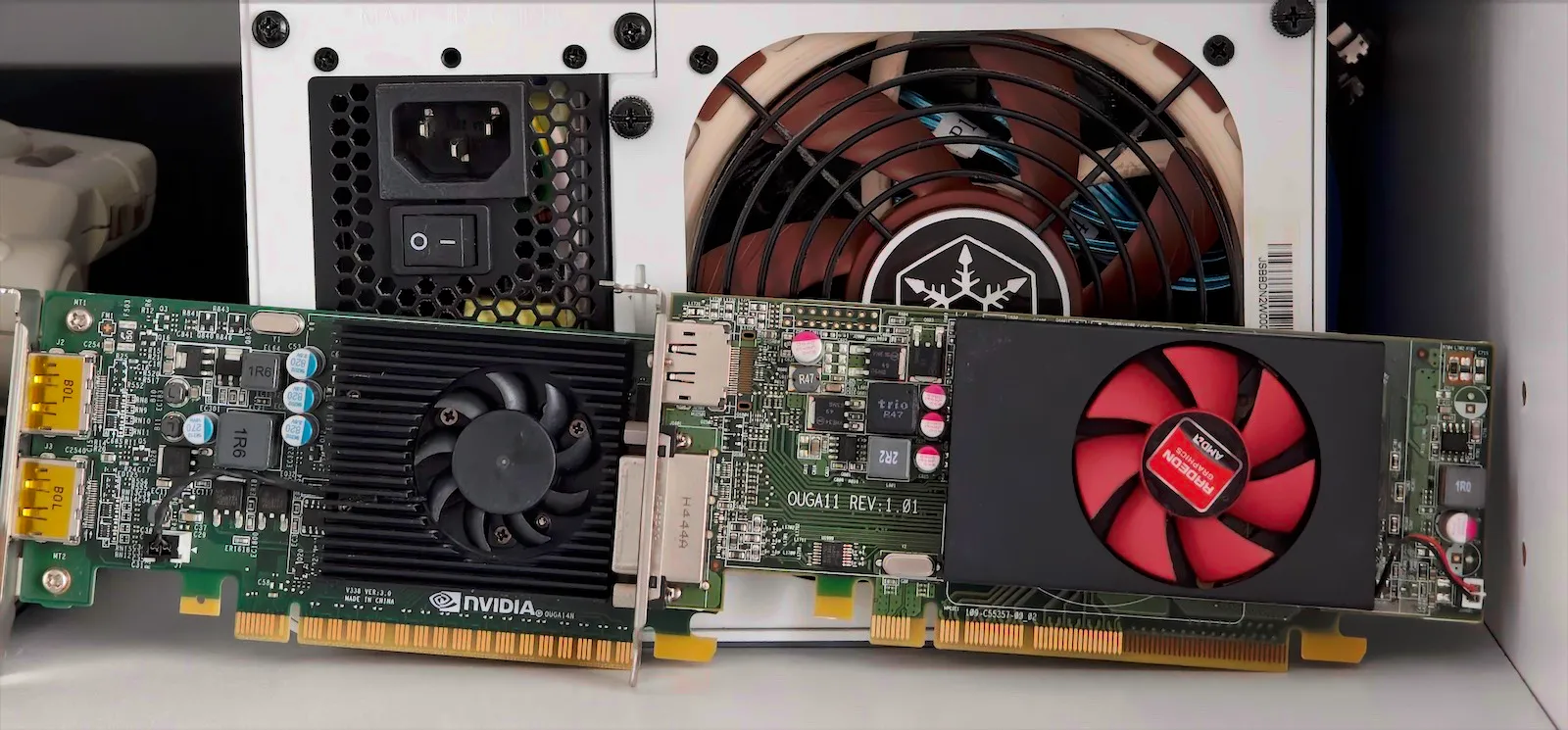
The 3600 doesn't have this capability, and neither does the 1200. With no graphics, neither CPU would POST. Did I buy two cheap graphics cards on eBay? Why, yes I did! ($10 each, one AMD and one NVidia.) Am I going to use them for this? No, I don't think so -- read on.
The 1200 turned out not to be the key I needed. It's in the drawer now anyway -- and yeah, I've already caught myself thinking a spare CPU and choice of GPUs is a great excuse to buy another motherboard, RAM and PSU, just so the 1200 has somewhere to live. Maybe that's the point of scrap-fi: Nobody keeps an old part because it's precious -- they keep it because one day it'll be the only thing that fits.
My dad used to do the same thing with mechanical and old radio parts. It might be genetic.
The one PCIe slot
The Jonsbo N2 has five hot-swap drive bays. The board has four SATA ports. The fifth drive needs a SATA adapter card, and the board has exactly one PCIe slot, which now might need a graphics card in it. A server can run headless -- in theory the GPU could come out once Proxmox is up -- but the day something breaks is the day you need a screen (unless you're running Talos, but I'm trying that on a different machine altogether). There are two M.2 slots, which means I could use an M.2 SATA adapter in one of them, but ... I already had a PCIe SATA adapter in my scrap drawer. It made more sense to also buy a Ryzen 3 3200G from eBay.
At this point my cheap "upgrade the NAS" project has gotta be running into the hundreds of dollars. Let's call it a hobby expense, because I'm actually really enjoying doing this.
Anyway, I've got the 3600 spare. Again.
Curious, I compared it online with my own PC: an MSI Z97 Gaming 5 with an i5-4690K, a Haswell chip from 2014, bought secondhand from a friend at work. Four cores, four threads, on a BIOS last updated in 2016 with nothing newer to flash. The "old" 3600 has six cores and twelve threads. My son's hand-me-down was better than my main machine. Back to the scrapyard for a secondhand ASRock B550M (~$100), and the Ryzen 5 will become my upgrade.
(Ah, that's a pip: my PC is DDR3, and the 32GB I have won't transfer. So I need even more DDR4. Maybe I can run a single DIMM until I can save up for more?)
Once the upgrade is done, the Z97 board, the i5, 32GB of DDR3 and a spare 550W PSU will be sitting in the cabinet next to the 1200, two $10 graphics cards, and the old Kabini board from the NAS. (The PSU came out of my son's PC when it started randomly shutting off under load. Everything in this story comes out of something else.) That's most of a computer. Every project leaves enough behind to start the next one, and the pile never gets smaller.
From spares to nostalgia
So what do you do with most of a computer? I could mini-rack it. Or I could 3D print a retro case and LARP having an IBM JX 5511.
That not really a choice for someone like me, is it?
The JX was my first computer. Dad brought it home from some guy at the pub. It was IBM's follow-up to the PCjr, in dark grey, and sold only in Australia, New Zealand and Japan. No hard drive. Two cartridge slots we never used. And a "wireless" keyboard with the infrared transmitter hidden inside the cable port, which we kept plugged in anyway because the infrared was terrible.
On the JX, and later a 286, I played Alley Cat, Castle Adventure, BattleTech, Grand Prix Circuit and Deathtrack. I learned to program in BASIC and Pascal. I hacked boot disks, and hex-edited shareware so it looked like I'd registered. That was my first taste of scrap-fi, really: getting a machine to do something it wasn't meant to, with whatever tools I had.
(I've got form here. An old Mac Mini I "souvenired" from work lives in a printed SGI Indigo2 case, and I built a HaikuBox in a printed case around an old Acer Aspire board. But the JX is the one that matters.)
So I asked Claude to help me build a parametric model of it in Python. Parametric means the measurements are variables rather than fixed numbers, so if the Z97 board or the drive doesn't quite fit, I change a number and regenerate. It's all on GitHub, if you fancy printing your own. The filament is charcoal grey PETG-CF, to match the original's dark grey, and I've ordered both a DVD-RW drive and an actual floppy to go in the front.
Is it LARPing to replace the BIOS boot logo and run PC-DOS on it? Yes, but I love it.
The happy path
A few nights ago I watched the Slow Horses season finale and then started playing Stray, and the combined heartbreak gave me a very specific dream. I was a 21st-century AI, and I'd woken up because some autonomous systems had found me in the rubble and "lifted" me: ported me to new architecture and given me a fuller sentience. Other entities welcomed me, since apparently this sort of thing happens all the time. One of them had a time-keeper with symbols they'd never bothered decoding, but I could. Twenty million years had passed since I was last switched on.
(In the dream, I started freaking out, unable to comprehend that much time. I had to sit down, come to grips with 100 years, then 1000. I was still working up to the full span when I woke up.)
But I don't think we need twenty million years and the death and rebirth of civilisation. I keep thinking about the buildings full of hardware we're putting up right now.
Remember the DDR4? It got expensive partly because the memory makers moved their factories over to HBM for AI accelerators. That boom is soaking up memory, GPUs, power and money at a rate nobody seems sure can last. If it doesn't -- if some of the big AI companies fold and some of those data centres go dark -- all that hardware doesn't disappear. It gets sold off, by the pallet, to whoever turns up.
Not much of it will fit in a Jonsbo: data-centre GPUs often come as modules rather than cards, and the racks expect liquid cooling and power supplies nobody has at home. But scrap-fi means adaptation, and the homelab crowd has it covered: some run retired Tesla P40s for local models, and you can already buy boards that let an old SXM2 data-centre GPU sit in an ordinary PCIe slot. Give that crowd a glut and they'll work out the rest.
In Andor, Ferrix is a whole town that lives off salvage: scrapyards break down old ships for parts, and the story starts with Cassian selling a piece of stolen Imperial tech on the black market. The Empire's hardware, in the hands of people who'll find another use for it. That's the happy path for an AI bust. The hardware doesn't vanish into landfill; it ends up in garages and spare rooms and on desks like mine, doing jobs it was never designed for. It's not the sleek future we were promised -- although how many scifi settings are pristine and shining? Even Star Trek's Federation has a dark side, with either creaking old reclaimed space-stations (DS9), let alone Section 9.
The pile abides
So here's where everything stands:
- My son's PC: a Ryzen 7 5700X, four matching sticks of DDR4, a new PSU, and the RTX 4070 I swapped him for his 2070 last year. One of only two machines in the house that's actually finished -- until I tear down my own PC, that is.
- The NAS: Jonsbo N2, JGINYUE board, Ryzen 3 3200G on its way, his old PNY XLR8 RAM, a SATA card in the one PCIe slot and five drives. I'll probably have to reinstall, because I've changed which drive should hold the operating system.
- My PC: Still the Intel machine, but planning to become a Ryzen 5 3600 once the ASRock B550M arrives (and I buy some DDR4), plus the RTX 2070 and drives from the old build.
- The pile: a Ryzen 3 1200, two $10 graphics cards, the old Kabini board, random DDR3 DIMMs.
- The IBM JX: a parametric model (and a roll of charcoal grey PETG-CF) of a case to hold the MSI Z97 with i5-4690K, 32GB of DDR3, a 550W PSU, DVD-RW drive, and a floppy drive (and appropriate adapter).
When I built that NAS in 2022, I wrote that the Kabini's integrated Radeon graphics was something "I'm not likely to use at all." Four years later, not having integrated graphics cost me two CPUs, two graphics cards and most of a month.
I'm already living in the scrap-fi future. I'll let you know how it goes!